“I’m just not a natural salesperson.”
I’ve heard that so many times over the years, usually from perfectly capable people who know their product inside out, understand their customers and are very good at what they do. Somewhere along the way, though, they’ve decided that to be good at sales you need a certain type of personality. You need to be naturally confident, outgoing, quick with an answer and probably have the gift of the gab.
I really don’t believe that’s true.
Some of the best salespeople I’ve worked with aren't stereotypical salespeople at all. They're knowledgeable, curious and genuinely interested in helping their customers. They may not be the loudest person in the room, but they listen, ask good questions and know how to have a useful conversation.
So, if you've ever wondered how to be good at sales when selling doesn't feel particularly natural to you, perhaps it's time to stop worrying about whether you were born to sell and start looking at the skills you can actually learn.
What Does Being Good at Sales Actually Mean?
For me, being good at sales means understanding your customer, asking useful questions, listening properly and then using your knowledge to help them make a decision that's right for them. It isn't about being persuasive for the sake of it, and it certainly isn't about talking somebody into buying something they don't need.
That's a very different version of sales from the one many people have in their heads.
This is particularly important in technical and B2B sales, where your customer may have a complicated problem and you may have a complicated solution. You can't really understand what they need if you're spending the whole meeting waiting for an opportunity to tell them how brilliant your product is.
Quite often, the person who listens better will have a far more productive sales conversation than the person who talks better.
You Don't Need the Gift of the Gab
I've worked with technically excellent people who initially lacked sales confidence because they thought they needed to become someone else when they walked into a sales meeting. They knew their products, understood the technology and could solve incredibly complex customer problems, but the word sales made them feel as though they suddenly needed to perform.
They didn't.
What they needed was a little more structure around their conversations, some better questions and the confidence to stop talking occasionally and let the customer tell them what was really going on.
Once you make that shift, sales can start to feel much more natural. You're no longer trying to deliver the perfect pitch. You're having a conversation with another human being, finding out what's happening in their world and deciding whether what you offer can genuinely help.
That's one of the things I focus on in my sales training. I'm not trying to turn people into stereotypical salespeople. I'm helping them develop practical sales skills that work with the person they already are.
Confidence Usually Comes After Competence
I think we sometimes get confidence the wrong way round. We tell ourselves, “Once I feel more confident, I'll be better at sales.” In reality, confidence often develops because you've learnt what you're doing and you've practised it enough times that it stops feeling unfamiliar.
Golf is a good example. You don't stand on the first tee as a beginner feeling completely confident about your swing. You learn the technique, you practise, you get things wrong, you make adjustments and eventually some of it becomes automatic. I'm still waiting for all of my golf swing to become automatic, but that's another story!
Sales works in much the same way.
You learn how to open a conversation comfortably. You get better at asking discovery questions. You learn how to qualify an opportunity rather than assuming every enquiry is a good one. You become more comfortable talking about value, handling objections and agreeing what should happen next.
The more competent you become, the less scary those conversations feel. Confidence starts to follow.
The Real Problem Might Be Your Definition of Selling
This, I think, is where a lot of the discomfort around sales actually comes from.
If your definition of selling is convincing people, pushing products and closing at all costs, it's perfectly understandable that you might decide you're not very good at it. I wouldn't particularly want to be good at that version of sales either.
But what if selling means being curious about someone's business? What if it means understanding a problem properly before suggesting a solution? What if it's simply using your experience and knowledge to help someone make a good buying decision?
That feels very different.
For technical people especially, this can be quite liberating because your technical knowledge is already a huge advantage. The sales skill is learning how to use that knowledge in a customer conversation without overwhelming them with information they don't need.
Confident Selling™ Insight
You don't become confident and then start selling well. You learn how to sell well… and confidence follows.
Try This in Your Next Sales Conversation
Before your next customer meeting, rather than thinking “How am I going to sell this?”, ask yourself a different question:
“What do I need to understand?”
It's a very small change, but it completely changes where you put your attention. Instead of preparing to perform, you're preparing to understand. You'll probably ask better questions, listen more carefully and uncover far more about what actually matters to the person sitting opposite you.
And once you understand that, you can decide whether you can help.
That's good selling.
You Really Can Learn to Be Good at Sales
After more than 30 years in technical B2B sales, one thing I firmly believe is that sales skills can be learnt. Of course some people will naturally find certain parts easier than others, just as they do with anything else, but you don't need to become louder, slicker or more extroverted to improve.
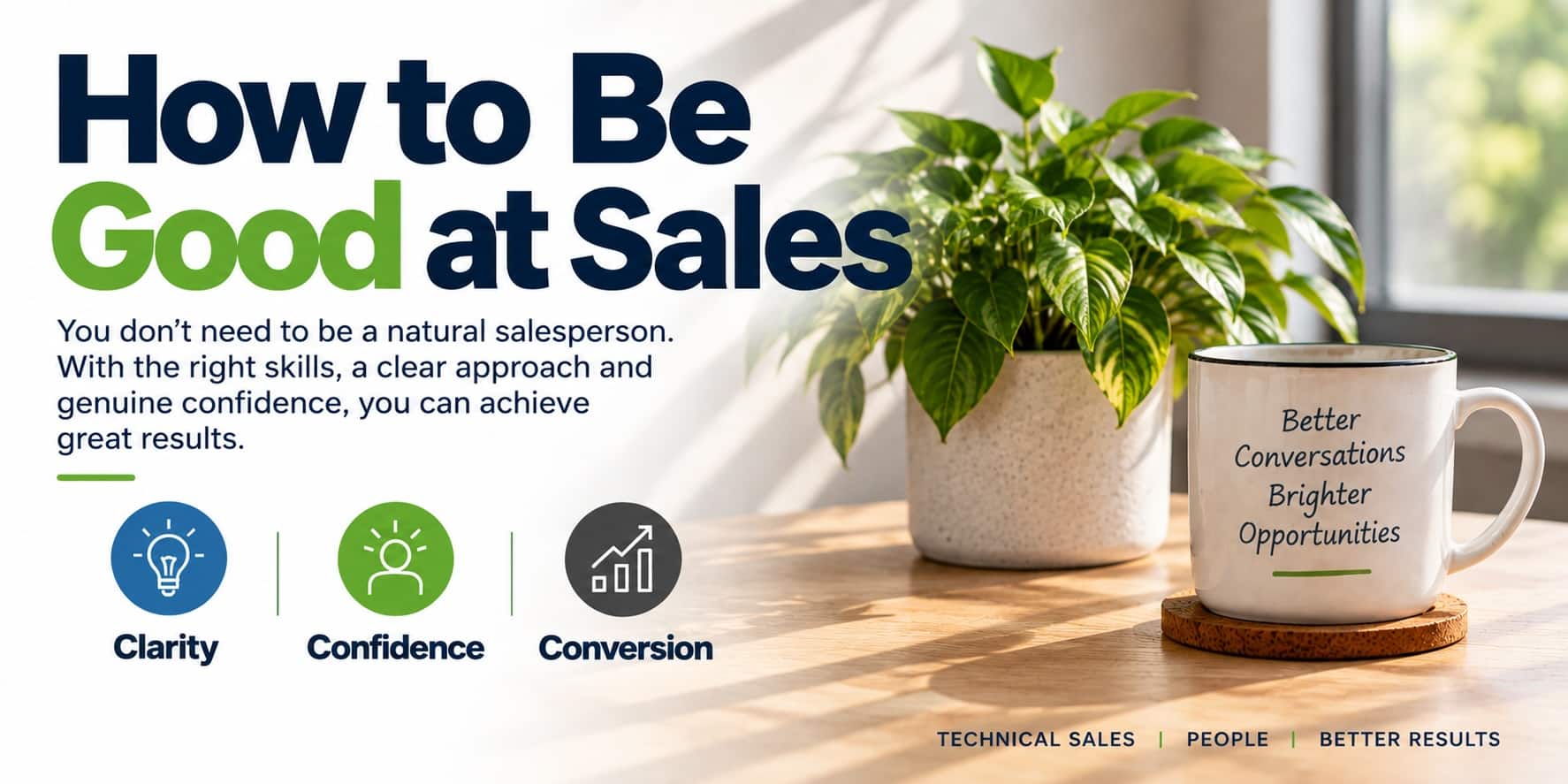
You need the right skills, a clear approach and the opportunity to practise until those skills begin to feel natural.
It's also one of the reasons I wrote Confident Selling™: The Core Guide. I wanted to take away some of the mystery and awkwardness around selling and show that there's a much more human way to do it.
Because sales really isn't scary. With the right skills, knowledge and tools, it can actually be fun.
FAQ
Yes. Good selling relies heavily on learnable skills such as questioning, listening, communication, qualification and understanding customer needs.
Build your skills and practise them consistently. Confidence usually increases when you have a clear approach and know what to do during a sales conversation.
No. Listening, curiosity, empathy and asking good questions can be much more valuable than being naturally outgoing.
